How Many Sunrises Have I Seen?
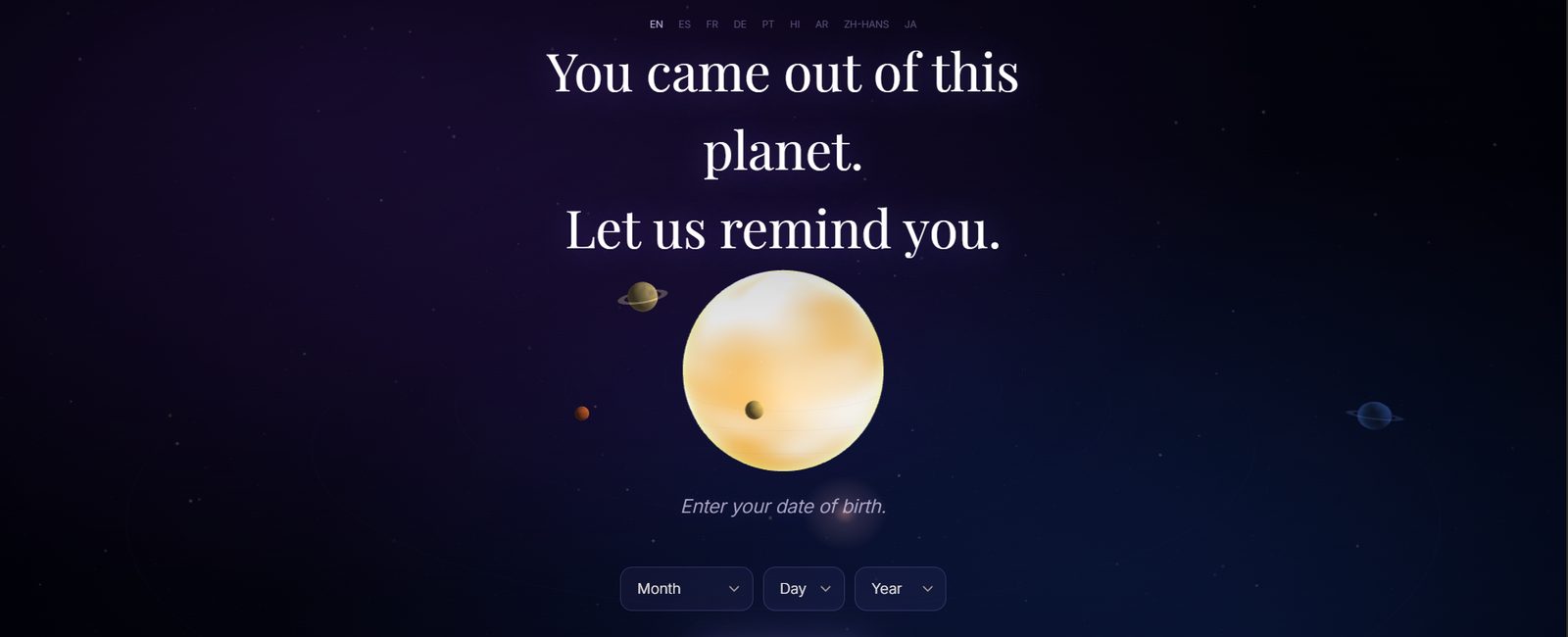
Every single day of your life, the Earth has rotated to bring your part of the planet back into sunlight. Not most days. Every day. The question is not whether the sunrise happened. It always did. The question is how many times it has happened since the day you were born.
The Numbers
The calculation is deceptively simple. One sunrise per day, every day, for the duration of your life. A 30-year-old has experienced approximately 10,957 sunrises. A 50-year-old, roughly 18,262. By age 80, the sun will have risen for you over 29,220 times.
Every single one of those sunrises was unique. No two were the same colour, the same speed, or the same shape. You have never seen the same sunrise twice.
That is not poetic exaggeration. It is atmospheric physics.
Why the Sun Rises: Earth's Rotation
A sunrise is not the Sun moving. It is you moving. The Earth rotates on its axis once every 23 hours, 56 minutes, and 4 seconds. This is known as the sidereal day, the time it takes for the Earth to complete one full rotation relative to the distant stars. The reason our clocks say 24 hours is that the Earth must rotate a tiny bit extra each day to compensate for its orbital motion around the Sun. That extra four minutes gives us the solar day we experience.
According to NASA, the Earth rotates at approximately 1,670 kilometres per hour at the equator. You are, right now, spinning through space at extraordinary speed. Every sunrise is your part of the planet rotating back into the light after spending hours in its own shadow.
Why Every Sunrise Looks Different
The reds, oranges, pinks, and golds of sunrise are created by a phenomenon called Rayleigh scattering. When sunlight enters the atmosphere, it collides with gas molecules. Shorter wavelengths of light (blue and violet) scatter more easily in all directions, while longer wavelengths (red and orange) pass through more directly.
At sunrise, the sunlight must travel through a much thicker slice of atmosphere than at midday, because it enters at a low angle. This extra distance strips away almost all of the blue light, leaving predominantly red and orange wavelengths to reach your eyes. The exact colours depend on the amount of dust, moisture, and aerosols in the atmosphere at that precise moment, in that precise location.
This is why a sunrise after a rainstorm looks different from a sunrise on a dry, dusty morning. It is why sunrises over the ocean differ from sunrises over mountains. The atmosphere is never identical from one morning to the next. Every sunrise you have ever witnessed was a one-time event, a specific combination of light, atmosphere, and geometry that will never repeat.
Axial Tilt and the Shifting Sunrise
The Earth's axis is tilted at approximately 23.44 degrees relative to its orbital plane. This tilt is the reason seasons exist, and it is also the reason the sunrise changes position on the horizon throughout the year.
In the Northern Hemisphere summer, the sunrise point shifts northward. In winter, it shifts southward. At the equinoxes, the Sun rises almost exactly due east everywhere on Earth. At the summer solstice, the sun barely sets at all near the Arctic Circle. This is the midnight sun. At the winter solstice, the same locations experience almost no sunrise at all.
This means that the sunrise you see today is not only a different colour from yesterday's but is also rising from a slightly different point on the horizon. The entire geometry of your morning is in constant, slow motion.
The Sunrise You Cannot See
Of your thousands of sunrises, you were conscious for relatively few of them. Many happened while you slept. Some happened behind clouds. Some you were simply too busy to notice. The sunrise does not require your awareness. It requires only the rotation of the Earth, a process that has continued uninterrupted for 4.5 billion years.
Long before there were eyes to see it, the Sun rose over this planet. It rose over lifeless oceans, over the first single-celled organisms, over the forests of the Carboniferous, over the dinosaurs, and over every ancestor in your lineage stretching back hundreds of millions of years. Every one of them lived under the same rotating sky.
What Your Number Means
When you calculate how many sunrises have occurred since your birth, you are not counting something abstract. You are counting the number of times a planet carried you back into the light. Each rotation took roughly 24 hours. Each one was powered by the angular momentum left over from the formation of the solar system itself, 4.6 billion years ago.
You did not earn those sunrises. You cannot purchase more. You simply received them: ten thousand, twenty thousand, perhaps thirty thousand mornings, each one delivered to you by the physics of a spinning world.
Tomorrow morning, the Earth will rotate again. The light will arrive. Whether you watch it or not is the only part that is up to you.
Sources
NASA Earth Fact Sheet: Earth's sidereal rotation period is 23 hours, 56 minutes, 4.1 seconds. Equatorial rotation velocity is approximately 1,670 km/h. Axial tilt is 23.44 degrees.
Young, A.T. (various), Applied Optics & Journal of the Optical Society of America: Comprehensive studies on atmospheric Rayleigh scattering and its role in producing the colour variations observed at sunrise and sunset.
US Naval Observatory: Sunrise and sunset times, solar position calculations, and the geometric relationship between Earth's axial tilt and the shifting azimuth of the sunrise point throughout the year.
See how many sunrises have greeted YOU.
Enter your birthday →Seriously! We have something beautiful to show you.